What Is Some Art and Ktiture of the Indus River Valley
In this post, allow'due south see the features of Indus Valley Civilisation arts as part of the Indian Culture notes based on the NCERT text 'An Introduction to Indian Fine art' – Function 1. A detailed note about the features, sites, society, faith etc. of Indus Valley Civilisation is already published in this website. As nosotros have covered the prehistoric arts of India in the last article, we shall move to the next major era in the cultural history of India, ie. arts of Indus Valley.
Take the ClearIAS UPSC prelims mock test on Indian culture. You not only will learn the of import facts related to Indian culture, but will also start to dearest the subject!
Arts of Indus Valley Civilization
- The arts of Indus Valley civilisation, one of the earliest civilisations of the globe, emerged during the second half of the tertiary millennium (Bronze Age).
- The forms of art found from various sites of civilization include sculptures, seals, pottery, gold ornaments, terra cotta figures, etc.
- Their delineation of human being and animal figures was highly realistic in nature.
- Modelling of figures was washed in an extremely careful manner.
- Ii major sites of Indus Valley civilization, forth the river Indus are: North – cities of Harappa;S – Mohenjo-Daro.
- The site showcase ane of the earliest examples of civic planning.
- Houses, markets, storage facilities, offices, etc. arranged in a grid-similar design.
- In this blueprint, roads were cut across one some other in xc-degree angle and the city was divided into blocks.
- There was likewise a highly developed drainage system.
- While Harappa and Mohenjo-Daro are situated in Islamic republic of pakistan, the important sites excavated in Bharat are:
- Lothal, Surkotada, Dholavira – Gujarat
- Rakhigarh and Banwali – Haryana
- Ropar – Punjab
- Kalibangan and Balatha – Rajasthan
Materials used: Stone, Bronze, Terra cotta, Clay etc.
The arts of Indus valley which are excavated yet are:
Stone Statues:
- Stone statues found in Indus valley sites are excellent examples of handling the 3D book.
- Two major stone statues are:
- Bearded Human (Priest Man, Priest-King)
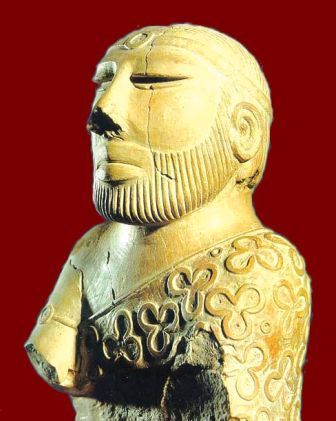

- Plant in Mohenjo-Daro.
- Bearded man'southward figure made ofSteatite.
- The effigy interpreted as a priest and is draped in a shawl coming under the right arm and covering the left shoulder.
- The shawl is decorated with trefoil blueprint.
- The eyes are elongated and half closed every bit in a meditative concentration.
- Nose is well formed and medium size.
- Short cutting moustache and a short beard and whiskers.
- Hair is parted in the eye and a plain woven fillet is passed round the head.
- An armlet on the right hand and holes around neck suggest necklace.
- A slight touch of the Greek mode of statues can be seen overall.
- Male Body
- Found in Harappa (only major art chemical element found in Harappa).
- Made of Red Sandstone.
- There are socket holes in the neck and shoulders for the attachment of head and arms.
- Legs are cleaved.
- The shoulders are well baked and the abdomen slightly prominent.
- 1 of the well carved and finished work.
Bronze Casting:
- Statuary casting was practiced in wide scale in almost all major sites of the civilization.
- The technique used for Statuary Casting was Lost Wax Technique.
[Initially, the figure needed is made of wax and covered it with clay. Afterwards immune to dry the clay, the whole thing is heated so that the wax inside the dirt will exist melted. The molten wax was then drained out through a tiny hole made in the clay role. The hollow mold of clay thus created was filled with molten metallic. Once information technology cooled, the clay embrace was completely removed].
- Homo as well as animal figures are nowadays in the Statuary casting.
- Amongst brute figures the buffalo with its uplifted caput, dorsum and sweeping horns and the goat are artistic merits.
- Copper domestic dog and bird of Lothal and the Statuary figure of a bull from Kalibangan shows that Bronze casting was popular at all centers of Indus valley civilization.
- Metal casting continued even after the Indus valley civilization through late Harappan, Chalcolithic people, etc.
- Examples of Bronze casting are:
- Dancing Girl
- Found from Mohenjo-Daro.
- Made upward of Statuary.
- One of the best-known artifacts from Indus valley.
- Approximately 4-inch high figure of a dancing daughter.
- This exquisite casting depicts a daughter whose long pilus is tied in the bun and bangles cover her left arm.
- Cowry beat necklace is seen effectually her cervix.
- Her right paw is on her hip and her left hand is clasped in a traditional Indian dance gesture.
- She has large eyes and flat olfactory organ.
- Balderdash from Mohenjo-Daro
- Bronze figure of the bull institute in Mohenjo-Daro.
- The massiveness of the bull and the fury of the accuse are eloquently expressed.
- The brute is shown standing with his head turned to the correct.
- At that place is a string around the neck.
Terracotta:
- Terra cotta figures are more than realistic in Gujarat sites and Kalibangan.
- In terra cotta, nosotros observe a few figurines of bearded males with coiled hairs, their posture rigidly upright, legs slightly autonomously, and the artillery parallel to the sides of the body. The repetition of this figure in exactly the same position would suggest that he was a deity.
- A terra cotta mask of a horned deity has also been found.
- Toy carts with wheels, whistles, rattles, bird and animals, gamesmen, and discs were likewise rendered in terra cotta.
- The most important terracotta figures are those represent Mother Goddess.
- Female parent Goddess
- Mainly establish in Mohenjo-Daro.
- These figures are usually crude standing figures.
- Adorned with necklaces hanging over the prominent chest and wearing a loin cloth and a grid.
- The fan-shaped headdress with a cup like projection on each side is a distinct decorative characteristic of the mother goddess.
- The pellet eyes and beaked nose of the figure are very crude (constructed in a rudimentary way).
- Rima oris is indicated by a narrow opening.
Seals:
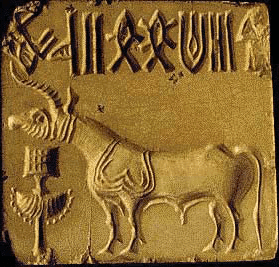
- Thousands of seals were discovered from the sites, usually fabricated of steatite, and occasionally of agate, chert, copper, faience and terracotta, with beautiful figures of animals such as unicorn bull, rhinoceros, tiger, elephant, bison, goat, buffalo, etc.
- The purpose was mainly commercial.
- They were also used as amulets, carried on the persons of their owners, perhaps as modernistic identity cards.
- Standard Harappan seal was 2 x 2 foursquare inches.
- Every seal is engraved in a pictographic script which is all the same to exist deciphered.
- Some seals were too been found in Gold and Ivory.
- Seals of Pashupati Mahadeva
- Plant in Mohenjo-Daro.
- The seal depicts a human figure seated cross legged.
- An elephant and a tiger are depicted to the right side of the figure, while on the left a rhino and a buffalo are seen.
- Two antelopes (deer) are shown beneath the seat (nearby his feet).
- The figure has a three horned head.
Pottery:
- Indus valley pottery consists of very fine bike made wares, very few beingness handmade.
- Plain pottery is more common than painted ware.
- Obviously pottery is generally ruby dirt, with or without a fine scarlet or grey slip.
- The black painted ware has a fine coating of scarlet skid on which geometric and fauna designs are executed in glossy black pigment.
- Painted Earthen Jar
- Found in Mohenjo-Daro.
- Made on a potters' bicycle with dirt.
- The shape was manipulated by pressure of the crafty fingers of the potter.
- Afterwards baking a clay model, information technology was painted with black colour.
- High polishing was done as a finishing touch.
- Motifs are vegetal and geometric forms.
- Designs are simple.
Beads, Ornaments and Cosmetics:
- The Harappan men and women decorated themselves with a large variety of ornaments produced from every conceivable materials ranging from precious metals and gemstones to bone and broiled clay.
- White necklaces, fillets, armlets and finger rings were commonly worn by both sexes.
- Jewellery found at Mohenjo-Daro and Lothal include necklaces of gold and semiprecious metal stones, copper bracelets and chaplet, aureate earrings and head ornaments.
- A cemetery has been found at Farmona in Harappa where dead bodies were buried with ornaments.
- Well adult bead industries were nowadays at Chauhudaro and Lothal.
- Some beads were fabricated of two or more stones cemented together.
- Also made models of animals, particularly monkeys and squirrels, used as pin head and beads.
- Spinning of cotton wool and wool was very mutual (both rich and poor practiced spinning).
- Men and women wore ii split up pieces of attire similar to dhoti and shawl.
- Shawl covered the left shoulder passing below right arm.
- They were conscious of fashion.
- Unlike hair styles were in vogue and beard was popular.
- Cinnabar was used as a corrective and face-paint, lipstick and collyrium (eyeliner) were also known to them.
Compiled past Jijo Sudashan


Reader Interactions
Source: https://www.clearias.com/arts-indus-valley-civilization/
0 Response to "What Is Some Art and Ktiture of the Indus River Valley"
Post a Comment