What Is the Legal Age to Buy a Gun in Arizona
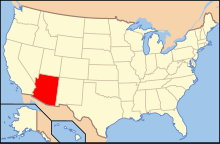
Location of Arizona in the United States
Firearm laws in Arizona regulate the sale, possession, and use of firearms and ammunition in the state of Arizona in the United States.
Summary table [edit]
| Subject field/Constabulary | Long Guns | Hand Guns | Relevant Statutes | Notes |
|---|---|---|---|---|
| Country permit required to purchase? | No | No | ||
| Firearm registration? | No | No | A.R.Due south. § 13-3108 | |
| Assail weapon law? | No | No | ||
| Magazine capacity brake? | No | No | ||
| Owner license required? | No | No | ||
| Permit required for curtained deport? | Due north/A | No | A.R.S. § xiii-3102 A.R.Southward. § 13-3112 | Arizona is a "shall result" state for citizens and lawful permanent residents who are 21 years or older. Permitless carry took effect on July 29, 2010. |
| Permit required for open deport? | No | No | May carry openly without permit. | |
| Castle Doctrine/Stand Your Basis law? | Yes | Yes | A.R.S. §§ 13-401 to 13-421 | |
| State preemption of local restrictions? | Yes | Yes | A.R.S. § 13-3108 | |
| NFA weapons restricted? | No | No | ||
| Shall certify? | Yes | Yes | A.R.S. § 13-3121 | Shall certify within 60 days. |
| Peaceable Journey laws? | No | No | ||
| Groundwork checks required for individual sales? | No | No | A.R.Due south. § 44-1382 |
Firearms carry [edit]
Open conduct [edit]
On foot, any adult person who is not a "prohibited possessor"[1] may openly conduct a loaded firearm visible to others without a permit. Generally, a person must be at least xviii years of age to possess or openly carry a firearm. Even so, this does not apply to:
- Juveniles within a private residence.
- Emancipated juveniles.
- Juveniles accompanied by a parent, grandparent or guardian, or a certified hunter safety instructor or certified firearms safety instructor acting with the consent of the juvenile'due south parent or guardian.
- Juveniles on private holding owned or leased by the juvenile or the juvenile'due south parent, grandparent, or guardian.
- Juveniles fourteen years of age and up engaged in any of the following activities:
-
-
- Lawful hunting or shooting events or marksmanship practice at established ranges or other areas where the discharge of a firearm is non prohibited.
- Lawful transportation of an unloaded firearm for lawful hunting.
- Lawful transportation of an unloaded firearm betwixt the hours of 5:00 a.m. and 10:00 p.m. for shooting events or marksmanship practice at established ranges or other areas where the belch of a firearm is not prohibited.
- Activities that require a firearm related to the production of crops, livestock, poultry, livestock products, poultry products, or ratites or in the production or storage of agricultural commodities.[2]
-
The law does not expressly require openly carried weapons to be in a holster, case or scabbard; withal, the open carrying of weapons non in a holster, instance or scabbard while on foot in a populated surface area could be construed as reckless display or, if others feel threatened past such, even assault with a deadly weapon.
In a vehicle, any adult person who is not a prohibited owner may openly conduct a loaded firearm in a vehicle whether in a holster, example, compartment, or in plain view. Persons under 21 may openly carry a loaded or unloaded firearm in a vehicle only if it is in plain view, i.e. discernible from the ordinary observation of a person located outside and inside the immediate vicinity of the vehicle.
Concealed behave [edit]
In Arizona, anyone who is not prohibited from owning a firearm and is at least 21 years old tin can conduct a concealed weapon without a permit every bit of July 29, 2010.[3] Arizona was the third country in modern U.S. history (later Vermont and Alaska, followed past Wyoming) to let the carrying of curtained weapons without a permit, and it is the get-go country with a big urban population to do so.[4]
Arizona is classified as a "shall issue" state. Even though Arizona law allows concealed conduct by adults without permit, concealed conduct permits are even so available and issued by the Concealed Weapons Permit Unit of the Arizona Department of Public Safety for purposes of reciprocity with other states or for carrying firearms in certain regulated places. Requirements for issuance include taking a training form (provided by a licensed tertiary party) or hunter didactics course, submitting a finger print carte, and paying a $60 fee. Applicants must be at least 21 years of age. New permits are valid for five years. [5] Renewing a permit requires an awarding and criminal background cheque.[6] Arizona recognizes all valid out-of-state bear permits.[7]
Land preemption [edit]
The Arizona legislature has largely preempted political subdivisions (counties, cities) to choose what laws that they want. Political subdivisions may regulate the conveying of weapons by juveniles or by their own employees or contractors when such employees or contractors are acting within the course and telescopic of their employment or contract. They may likewise bar the carrying of weapons at public establishments and events by those who do not take concealed deport permits. Public establishments and events where carry by not-permit holders is prohibited must provide secure storage for weapons on-site, which must be readily accessible upon entry and allow for immediate retrieval upon leave.[eight]
Tribal law [edit]
Native American reservations, which contain over a quarter of the land surface area of the state,[9] may have gun laws identical to or more restrictive than state police.[10] [11] Some tribal governments in Arizona may not recognize Arizona law on the concealed carrying of firearms without a permit while on tribal land.[11]
All Arizona tribes recognize federal police, including the "safe passage" provision of the federal Firearm Owners Protection Act Deed (FOPA). FOPA provides that, nonetheless any state, tribal, or local law, and while making a continuous journey, a person who is not a prohibited owner is entitled to transport a firearm or ammunition for any lawful purpose from any place where he may lawfully possess and carry such firearm to any other place where he may lawfully possess and carry such firearm or ammunition if, during such transportation the firearm is unloaded, and neither the firearm nor any ammunition being transported is readily accessible or is directly accessible from the rider compartment of such transporting vehicle.[12] In vehicles without a torso, the unloaded firearm or armament must be in a locked container other than the glove compartment or console.[12] Recent U.S. Court of Appellate rulings have confirmed that FOPA`s protections only use to unloaded firearms non readily accessible to the traveler, and many tribal governments have strict laws with respect to firearms existence carried or transported on tribal lands.[12] [13] [xiv] For instance, in the event of a vehicle stop, Navajo Nation police will seize any loaded firearm found to be accessible to the driver or passenger.[13] [14] [15] and confiscated firearms are not returnable unless the owner can establish proof of ownership of the firearm and ammunition by presenting a bill of sale or other evidence at the police station at a after date.[fifteen]
Discharging a firearm [edit]
It is generally illegal to discharge a firearm within or into the limits of any municipality. However, this prohibition does not employ to persons discharging firearms in the post-obit circumstances:
- On a properly supervised range.
- In an area recommended as a hunting expanse by the Arizona Game and Fish Department, approved and posted every bit required past the chief of law. (Any such surface area may be closed when deemed dangerous by the master of police or the director of the Arizona Game and Fish Department).
- For the command of nuisance wildlife past permit from the Arizona Game and Fish Department or the United States Fish and Wild fauna Service.
- Past special let of the principal of police of the municipality.
- Equally required past an animal control officer in the performance of duties.
- Firing blank cartridges.
- More than a 1/four mile from whatsoever occupied structure as divers in section ARS 13-3101.
- In cocky-defense force, or defence force of some other person confronting an animal assault if a reasonable person would believe deadly physical force against the fauna is immediately necessary and reasonable nether the circumstances to protect a person from harm.
- In self-defense or, in defence force of some other person confronting a criminal attack every bit permitted past the laws regarding defensive use of forcefulness.[16]
Under Shannon's Constabulary, unlawful belch of a firearm inside a municipality is a class 6 felony,[17] with a presumptive i year imprisonment.[xviii]
According to the Arizona Gun Owners Guide by Alan Korwin, while discharging a firearm using blanks within the limits of a municipality is not expressly prohibited by law, disturbing the peace (ARS xiii-2904) or other charges could nonetheless utilize.[19]
Prohibited areas [edit]
State law prohibits the carrying of firearms in certain areas. These prohibited areas include:
- Hydroelectric or nuclear ability generating stations. Nonetheless, this does not utilise to:
-
- A peace officeholder or whatever person summoned past any peace officer to assist and while actually assisting in the performance of official duties.
- A member of the war machine forces of the The states or of any state of the United States in the functioning of official duties.
- A warden, deputy warden, customs correctional officer, detention officer, special investigator or correctional officer of the state section of corrections or the section of juvenile corrections.
- A person specifically licensed, authorized or permitted pursuant to an Arizona or federal statute.
- Polling places on election day. However, this does not apply to:
-
- A peace officer or any person summoned by whatsoever peace officeholder to assistance and while actually profitable in the operation of official duties.
- A member of the war machine forces of the U.s.a. or of any state of the United states in the performance of official duties.
- A warden, deputy warden, community correctional officer, detention officer, special investigator or correctional officer of the state department of corrections or the department of juvenile corrections.
- A person specifically licensed, authorized or permitted pursuant to an Arizona or federal statute.
- Secured areas of airports. Still, this does not apply to:
-
- General aviation areas not included in the security identification display expanse or sterile expanse as divers in the airdrome security program approved by the transportation security administration.
- The lawful transportation of deadly weapons in accordance with country and federal police force.
- A peace officeholder or a federally sworn officer while in the actual performance of the officer'southward duties.
- A member of the military forces of the United States or of any state of the United States in the bodily performance of the member'south official duties.
- An individual who is authorized past a federal agency in the actual performance of the individual's official duties.
- Inside a jail or on the grounds thereof.
- K-12 School grounds. However, this does not employ to:
-
- Firearms possessed for the purposes of preparing for, conducting or participating in hunter or firearm safety courses.
- Firearms for use on the school grounds in a program approved past the school.
- Unloaded firearms carried inside a ways of transportation and under the control of an adult, provided that if the adult leaves the means of transportation, information technology is locked and the firearms are not visible from the exterior.
- A peace officer or any person summoned by any peace officeholder to assistance and while actually profitable in the performance of official duties.
- A member of the armed forces forces of the United States or of whatever state of the U.s.a. in the performance of official duties.
- A warden, deputy warden, community correctional officer, detention officer, special investigator or correctional officer of the land department of corrections or the department of juvenile corrections.
- A person specifically licensed, authorized or permitted pursuant to an Arizona or federal statute.
- Establishments which are licensed to sell alcohol for consumption on the premises. However, this does not apply to:
-
- The licensee or an employee of the licensee acting with the permission of the licensee to be in possession of a firearm while on the licensed premises.
- A person who is on the premises for a limited fourth dimension to seek emergency aid, if such person does not buy, receive, consume, or possess alcohol while there.
- Hotel or motel invitee room accommodations.
- The exhibition or display of a firearm in conjunction with a meeting, show, form or similar event.
- A person with a curtained carry permit who carries a concealed handgun, provided that there is no properly notice posted forbidding such pursuant to A.R.S. 4-229, and provided that the concealed acquit let holder consumes no alcohol while on the premises.
- Peace officers or members of a sheriff's volunteer posse while on duty who accept received firearms training that is canonical by the Arizona Peace Officer Standards and Training board.
- Any private property or private institution where the owner or whatsoever other person having lawful control over the property has given reasonable notice forbidding the carrying of deadly weapons or firearms. However, this does not apply to:
-
- Officers of the law who are legally executing official duties
- Lawfully possessed firearms that are in a locked and privately owned vehicle or in a locked compartment on a privately endemic motorcycle and that are not visible from exterior the vehicle or motorcycle.
- Any public college or university where the conveying of deadly weapons or firearms has been prohibited by the governing board
- On the grounds of or in a secure intendance facility under the jurisdiction of the section of juvenile corrections
- In a correctional facility or the grounds of a correctional facility
In add-on, political subdivisions accept limited power to prohibit the carrying of firearms in sure areas as described in a higher place. Carrying a firearm at a jail, correctional facility, juvenile secure care facility, or in a hydroelectric or nuclear power generating station is a felony. Conveying a firearm in any other prohibited area, absent any other concomitant criminal conduct, is a misdemeanor. Carrying a firearm on private property or in a individual establishment where it has been forbidden by the owner or another person having lawful control over the property is non expressly prohibited by constabulary, but is held to constitute misdemeanor trespass.[20] Carrying a firearm at a public college or university where it has been prohibited by the governing board is non expressly prohibited by law, but is held to violate provisions of ARS 13-2911, which prohibits "interference with or disruption of an educational institution". The restrictions pertaining to licensed liquor establishments do not apply to liquor stores or other stores that sell only closed containers of booze for consumption off the premises.[21] [22] [23] [24] [25] [26] [27]
Prohibited possessors [edit]
Land constabulary prohibits the possession of firearms and other mortiferous weapons by certain categories of "prohibited possessors". According to electric current statute, these categories are defined as follows:
- Anyone who has been found to plant a danger to self or to others or to exist persistently or acutely disabled or gravely disabled pursuant to court society under ARS 36-540, and whose right to possess a firearm has non been restored pursuant to ARS 13-925.
- Anyone convicted of a felony, or who has been adjudicated runaway for a felony, and whose State civil correct to possess or comport a gun or firearm has not been restored by carve up order of the court.
- Anyone who has been found incompetent to stand trial and who has not subsequently been constitute competent.
- Anyone who has been guilty except insane of committing a crime
- Anyone who is, at the time of possession, serving a term of imprisonment in any correctional or detention facility.
- Anyone who is, at the fourth dimension of possession, serving a term of probation pursuant to a conviction for a domestic violence offense or a felony crime, parole, community supervision, work furlough, home arrest, or release on any other basis, or who is serving a term of probation or parole pursuant to an interstate compact.
- Anyone who is an undocumented alien or a nonimmigrant alien, traveling with or without documentation for business or pleasure, or who is studying in Arizona and maintains a foreign residence, except for:
-
- Nonimmigrant aliens who possess a valid hunting license or let lawfully issued by a land in the U.s..
- Nonimmigrant aliens who enter the United States to participate in a competitive target shooting outcome or to display firearms at a sports or hunting trade evidence sponsored by a national, state, or local firearms trade organization devoted to competitive or sporting use of firearms.
- Certain diplomats.
- Officials of foreign governments or distinguished foreign visitors who are designated by the Usa Department of Land.
- Persons who take received a waiver from the United States Attorney Full general.[28]
Notably, the prohibition against owning a firearm by a person establish to be a danger to himself or others or persistently or acutely disabled or gravely disabled continues in upshot even after the expiration of the mental wellness court order itself (365 days). Instead, a person whose correct to possess a firearm was forfeited equally office of a mental wellness club must have that right judicially restored past filing a petition with the court requesting a hearing and a court social club restoring the right to possess a firearm.[29]
Arizona appellate courts accept ruled that ARS 1-244 bars the retroactive application of changes to the prohibited possessor statute unless there is an express legislative declaration of retroactive intent.[30] Although the statute has been amended numerous times during its history, no such retroactive declarations have e'er been passed into police force. Thus, the possession of deadly weapons by some individuals may be governed by older versions of the statute which are either more than or less restrictive than the one currently in force. For example, persons found to plant a danger to self or others or to be persistently or acutely disabled or gravely disabled prior to September xxx, 2009 do not need to petition the courts for a restoration of rights, as statutes in consequence prior to that appointment either did not prohibit their possession of deadly weapons or prohibited such possession only temporarily, during their term of court-ordered treatment.
Prohibited weapons [edit]
State constabulary prohibits the possession of certain types of firearms and other deadly weapons past any citizen. These weapons are defined every bit follows:
- An detail that is a bomb, grenade, rocket having a propellant charge of more than four ounces is an explosive, incendiary or poison gas, or any combination of parts or materials that is designed and intended for use in making such or converting a device into such, unless it has been classified as a "curio or relic" under federal law, or is registered under the federal National Firearms Act.
- A device that is designed, made or adapted to muffle the study of a firearm, unless it has been classified equally a "curio or relic" under federal police force, or is registered nether the federal National Firearms Act.
- A firearm that is capable of shooting more than 1 shot automatically, without manual reloading, by a unmarried function of the trigger, unless it has been classified as a "curio or relic" under federal law, or is registered under the federal National Firearms Act.
- A rifle with a butt length of less than sixteen inches, or a shotgun with a butt length of less than 18 inches, or any firearm that is made from a rifle or shotgun and that, as modified, has an overall length of less than twenty-six inches, unless it has been classified equally a "curio or relic" nether federal police, or is registered under the federal National Firearms Act.
- A brittle container that contains a flammable liquid with a flash point of one hundred 50 degrees Fahrenheit or less and that has a wick or like device capable of existence ignited, or any combination of parts or materials that is designed and intended for utilize in making such or converting a device into such.
- A chemical or combination of chemicals, compounds or materials, including dry ice, that is possessed or manufactured for the purpose of generating a gas to cause a mechanical failure, rupture or bursting or an explosion or detonation of the chemical or combination of chemicals, compounds or materials.
- An improvised explosive device, or whatever combination of parts or materials that is designed and intended for use in making such or converting a device into such.[28]
Regarding police contact [edit]
- If a law enforcement officer contacts a person who is in possession of a firearm, the officeholder may take temporary custody of the firearm for the elapsing of that contact.[31]
- Equally of July 29, 2010, however, state constabulary no longer requires an private to carry a permit on their person.[3]
References [edit]
- ^ 'ARS xiii-3101 Archived April 13, 2011, at the Wayback Machine', retrieved 22 May 2012
- ^ "Arizona Revised Statutes Championship 13 Section 3111". Archived from the original on March 4, 2016. Retrieved September xiii, 2021.
- ^ a b Kiley, Kevin (July 29, 2010). "Arizona'south Concealed-Weapon Law Takes Effect" Archived April 4, 2015, at archive.today, Arizona Republic. Retrieved June 24, 2015.
- ^ "Arizona Legalizes Concealed Carry without Permit". Archived from the original on July 26, 2014. Retrieved July 24, 2014.
- ^ "Arizona Concealed Weapons Permit Unit – Obtaining a Permit". Archived from the original on February vii, 2009. Retrieved May 12, 2011.
- ^ "Arizona Concealed Weapons Permit Unit of measurement – FAQ". Archived from the original on August 15, 2008. Retrieved May 12, 2011.
- ^ ""AZ CCW Permit Reciprocity" on azccw.com". Archived from the original on April 5, 2011. Retrieved May 12, 2011.
- ^ "Arizona Revised Statutes Championship xiii Section 3108". Archived from the original on March 4, 2016. Retrieved September 13, 2021.
- ^ See east.1000. Navajo Nation, Navajo Nation Authorities Archived 2011-09-30 at the Wayback Machine, retrieved 31 October 2011
- ^ All about Arizona Archived November 20, 2017, at the Wayback Automobile. http://www.sheppardsoftware.com Archived May 12, 2011, at the Wayback Machine. Accessed 2010-09-21.
- ^ a b Tribal Laws and Concealed Behave Archived October 5, 2011, at the Wayback Machine, retrieved 31 Oct 2011: While tribal laws on criminal firearms violations utilise just to tribal members who live on reservation lands, they are still used every bit a guide to enforcement past tribal police for non-tribal members. If yous are company to a reservation and are carrying a firearm in a manner that would otherwise exist legal under Arizona law, such legal possession may not exist recognized by tribal law enforcement if it conflicts with tribal constabulary. Instead of arrest, tribal law enforcement will most probable confiscate the firearm and require the owner to go to tribal courtroom to become information technology back.
- ^ a b c Firearm Owners Protection Act Archived November ii, 2011, at the Wayback Machine, retrieved 31 October 2011
- ^ a b Navajo Nation Hunting and Trapping Information Archived Oct xi, 2011, at the Wayback Machine: Information technology is unlawful to possess a firearm with alive ammunition in the firing chamber in or on any motor vehicle.."
- ^ a b Navajo Nation Criminal Code: Unlawful carrying of deadly weapon T.17 – Section 320(A): Criminal offense. A person commits unlawful carrying of a deadly weapon if he or she carries a loaded firearm or whatever other type of deadly weapon; (B): Exceptions. Subsection (A) of this section shall not utilise to any of the post-obit: ... 2. To persons in private motor vehicle or other means of conveyance, for lawful protection of the person's or another's person or property, while traveling and such weapon is located in a closed body, luggage, or glove compartment of a motor vehicle
- ^ a b National Geographic, Navajo Cops, Season 255, Episode thirty, xi May 2011
- ^ "Arizona Revised Statutes Championship 13 Department 3107". Archived from the original on March 4, 2016. Retrieved September xiii, 2021.
- ^ Borrowman, Shane (2012). Trauma and the Teaching of Writing. SUNY Press. p. 47. ISBN978-0791484111. Archived from the original on September thirteen, 2021. Retrieved Jan 20, 2021.
- ^ "13-702 – First time felony offenders; sentencing; definition". Archived from the original on January 28, 2021. Retrieved January 20, 2021.
- ^ "Arizona Gun Owner's Guide – Updates". www.gunlaws.com. Archived from the original on April 21, 2021. Retrieved September 13, 2021.
- ^ Star, Tim Steller Arizona Daily. "Eateries wrestling with AZ gun laws". Arizona Daily Star. Archived from the original on September 13, 2021. Retrieved September thirteen, 2021.
- ^ "Arizona Revised Statutes Title thirteen Section 3102". Archived from the original on September 1, 2016. Retrieved September 13, 2021.
- ^ "Arizona Revised Statutes Title 13 Section 3119". Archived from the original on March 23, 2016. Retrieved September thirteen, 2021.
- ^ "Arizona Revised Statutes Title 4 Section 244". Archived from the original on June 10, 2011. Retrieved May 12, 2011.
- ^ "Arizona Revised Statutes Title 31 Section 129". Archived from the original on June 26, 2016. Retrieved September xiii, 2021.
- ^ "Arizona Revised Statutes Title 31 Section 2911". Archived from the original on November 24, 2011. Retrieved September 13, 2021.
- ^ "Arizona Revised Statutes Title 13 Section 2505". Archived from the original on September 13, 2021. Retrieved September 13, 2021.
- ^ "Arizona Revised Statutes Title 13 Section 2514". Archived from the original on March 23, 2016. Retrieved September xiii, 2021.
- ^ a b "Arizona Revised Statutes Title 13 Section 3101". Archived from the original on April 13, 2011. Retrieved May 12, 2011.
- ^ ARS thirteen-925(C); Arizona Superior Courtroom, Maricopa County, Guidelines for Report of Psychiatrist or Psychologist in Support of Petition for Restoration of Right to Possess Firearms Pursuant to A.R.Due south. § 13-925 (16 June 2011): Significantly, ARS 13-925(C) places the brunt of proof on the prohibited possessor (patient) at the restoration hearing to nowadays clear and convincing psychological or psychiatric evidence in back up of the petition to restore his/her right to possess a firearm. This would normally require the affirmation and/or testimony of a treating or evaluating psychiatrist or psychologist willing to assert that the circumstances that led to the original club, adjudication or finding are no longer in effect, that the patient is not likely to act in a mode that is unsafe to public safe, and that restoring the patient's correct to possess a firearm is not contrary to the public interest.
- ^ "State v. Griffin | 58 P.3d 516 (2002) | 8p3d5161568 | Leagle.com". Leagle. Archived from the original on September xiii, 2021. Retrieved September 13, 2021.
- ^ "View Certificate". www.azleg.gov. Archived from the original on April 29, 2021. Retrieved September xiii, 2021.
Source: https://en.wikipedia.org/wiki/Gun_laws_in_Arizona
0 Response to "What Is the Legal Age to Buy a Gun in Arizona"
Post a Comment